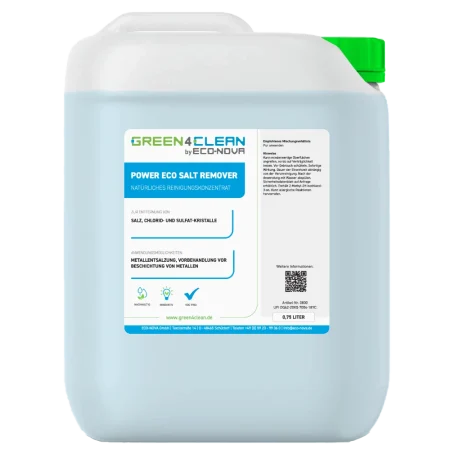
Item number: 0800

Power ECO Salt Remover

Water-based, acidic (pH approx. 3), with biodegradable surfactants
Water-based salt remover for removing microscopic salt crystals from corroded steel surfaces - as a pre-treatment before coating on offshore platforms, jack-up legs, wind turbines and in ship docks.
PowerECOSaltRemover_canister_en

Description of the

Power Eco Metal-Salt Remover is a water-based salt remover specifically developed for preparing corroded steel surfaces prior to the application of high-quality coatings. The product is mainly used in applications with high salt exposure - on offshore platforms, jack-up legs, offshore wind turbines and on ships during docking.

The mechanism of action targets the core problem of salt-contaminated steel surfaces: Chloride and sulphate crystals are located in the microscopic depressions of a corroded surface, which are invisible to the naked eye and cannot be reliably removed even by normal rinsing with water. If these salt residues are not removed before coating, they attract moisture under the fresh paint („osmotic blistering“) - the coating loses its protective effect long before its scheduled service life. Power Eco Metal-Salt Remover dissolves these salt crystals and thus enables coating preparation that achieves ISO-compliant measured values for residual salt content (Bresle test in accordance with ISO 8502-6).

In practice, the product offers a decisive advantage over the classic alternative method - blasting with abrasives. While sandblasting is costly in terms of logistics, waste-intensive and time-critical, the use of Power Eco Metal-Salt Remover is fast, compatible with scaffolding and gentle on the steel surface. This has a direct impact on profitability, especially for ships in the dock, whose lay time per day incurs considerable costs.

Available in: Four concentration variants, customised to the application and logistics: Concentrated - undiluted concentrate for dilution on site (typically 40 litres per 1,000 litres), supplied in 20 litre canisters; limited storage stability, therefore process promptly Solution 1 - pre-diluted application concentrate, economical adjustment (approx. 1:20) Solution 2 - pre-diluted application concentrate with activator, faster effect (approx. 1:20) RTU (Ready to Use) - ready-to-use dilution (1-10 %), no mixing required Standard container sizes for the ready-to-use variants: 20 L canister, 200 L drum, 1,000 L IBC (please confirm available containers per variant internally). Packaging

Advantages

Your advantages at a glance:

  • Removes microscopic salt crystals, which cannot be dissolved with water alone - a prerequisite for a long-lasting coating
  • Faster than blasting - Application and rinsing instead of a time-consuming blasting campaign; directly saves demurrage costs for ship dock applications
  • No CLP hazardous substance labelling - Simple storage on platforms, supply vessels and in shipyards
  • No dangerous goods according to ADR - Uncomplicated transport between mainland base and place of use
  • WGK 1 (slightly hazardous to water) - Lower risk compared to classic acidic salt removers
  • Biodegradable surfactants according to Regulation (EC) No 648/2004 (Detergents Regulation)
  • Not flammable (auto-ignition temperature > 200 °C)
  • Foam formation during spray application - Visible effect control and good service life on vertical surfaces
  • Four concentration variants - Precisely tailored to the logistics on site, from the ready-to-use RTU to the 40:1,000 concentrate for large-scale applications
  • International practical experience - from the established US market for coating pre-treatment to the European offshore sector

Application

Power Eco Metal-Salt Remover is the right choice wherever salt-contaminated steel is to be coated:

  • Offshore platforms - Jackets, pedestals, steel structures, railings, lifting gear
  • Jack-up legs - particularly critical because they are regularly taken out of the water and directly exposed to salt pollution
  • Offshore wind turbines - Transition pieces, internal structures, platform components
  • Ships in dock - Hull areas, superstructures, ballast water tanks (within the scope of the respective authorisation situation)
  • Harbour and shipyard applications - Steel components prepared on land before coating application
  • Refurbishment of existing systems - where a coating needs to be renewed and salt contamination is proven
  • Corrosion protection expertise - as an authorised procedure in addition to or instead of blasting

Typical clients and users:

  • Coating and paint manufacturers (e.g. for pre-treatment as part of their system)
  • Operators of offshore facilities (oil & gas, wind power)
  • Specialised maintenance companies for offshore structures
  • Shipyards and dock operators
  • Independent corrosion protection experts who carry out salt content measurements (e.g. Bresle test in accordance with ISO 8502-6) and approve a pre-treatment process

Technical data

Characteristic value Value
Product basis Water-based, acidic, with biodegradable surfactants
Appearance Clear liquid
Colour Blue
Odour Characteristic
pH value (concentrate) approx. 3
Density (20 °C) approx. 1 g/cm³
Water solubility Miscible
Viscosity (20 °C) < 1,000 mPa-s
Flash point Not applicable (water-based, non-flammable)
Auto-ignition temperature > 200 °C
Oxidising properties Not oxidising
CLP classification No labelling required
EUH labelling EUH208 (contains MIT, may cause allergic reactions), EUH210
ADR / Dangerous goods No dangerous goods
Water hazard class (WGK) 1 (slightly hazardous to water, self-classification)
Storage class (TRGS 510) 12
Biodegradability Surfactants Complies with Regulation (EC) No 648/2004

Binding characteristic values: see current safety data sheet (version 1.0.0, status 11.02.2026) and technical data sheet.

Processing instructions

Important in advance - mixing water: Power Eco Metal-Salt Remover may only be used with Distilled or fully demineralised water be mixed and applied. Tap water, process water or even salt water already contains chlorides and counteracts the effect of the product - the result in the Bresle test would not be reproducible. The four variants are designed for this requirement: RTU for applications without mixing facilities, Concentrated for users with their own mixing and water treatment infrastructure.

Choice of variants and dilution:

Variant Application Dilution
RTU Direct spray application without mixing Ready to use (1-10 % effective)
Solution 1 Standard use with mixing on site approx. 1:20 with distilled water
Solution 2 Faster action with activator - when time is critical approx. 1:20 with distilled water
Concentrated Large-scale applications with own mixing plant approx. 40 litres per 1,000 litres of distilled water

Application sequence in coating preparation:

  1. Preliminary inspection by corrosion protection expert: Salt content of the steel surface is measured (standard: Bresle test according to ISO 8502-6). The expert decides whether salt remover application is necessary, whether blasting is required or whether a combination of both methods is appropriate.
  2. Degreasing and derusting the surface - Coarse soiling, grease and loose rust particles are removed before the salt remover treatment.
  3. Set up cladding and fall arrest system: Scaffolding around the component to be treated (e.g. jacket leg, stand) is enclosed with foil so that cleaning water can be collected in a controlled manner. At sea, complete containment is generally mandatory.
  4. Spraying on the Salt Remover - with a spray lance, low-pressure sprayer or foam lance over the entire treatment area.
  5. Application time approx. 15 minutes - the product foams up visibly and dissolves the salt crystals from the microscopic cavities.
  6. Rinsing with a high-pressure cleaner - with distilled or fully demineralised water. Rinsing water is collected via the collection system and disposed of in accordance with local regulations.
  7. Salt content remeasurement by expert - A Bresle test is used to check whether the surface reaches the agreed cleanliness level. Second pass if required.
  8. Coating application - After approval by the expert and drying of the surface, the coating system can be applied.

Notes on foam formation: Foam formation during spray application is desirable and shows that the product remains in contact with the surface for a sufficiently long time on vertical surfaces. On very smooth or vertically overhanging surfaces, a foam lance can further improve the service life.

Material compatibility: Power Eco Metal-Salt Remover is acidic (pH approx. 3). Paint, plastic and sealing areas that are not to be treated must be protected by the collection system anyway. In the case of special materials (e.g. certain aluminium alloys or galvanic coatings), we recommend test cleaning in an inconspicuous area and consultation with the application technology department before using over the entire surface.

SAFETY & SECURITY

Storage location: Dry, well ventilated, protected from frost, direct sunlight and heat. Keep container tightly closed.
Storage temperature: 5-30 °C recommended. Protect from frost and heat.
Storage class (TRGS 510): 12.
Original packaging: Only store the product in the original container. Concentrated variant has limited storage stability (ingredients may settle) - use as soon as possible and stir thoroughly before use.

Personal protective equipment:

  • Eye/face protection: Safety goggles in accordance with EN 166 (protection against liquid splashes)
  • Hand protection: Liquid-tight, chemical-resistant protective gloves (e.g. PVC, chloroprene, nitrile or butyl rubber, EN 374, breakthrough time > 480 min, material thickness > 0.5 mm). Disposable gloves are sufficient for short-term contact.
  • Body protection: Suitable work clothing
  • Respiratory protection: Normally not required; provide respiratory protection in case of aerosol formation (e.g. when spraying in closed rooms).

General information: Avoid contact with skin, eyes and clothing. Product contains 2-Methyl-2H-Isothiazol-3-On (MIT) in low concentration as a preservative - may cause allergic skin reactions in sensitised persons.

In case of accidental release:

  • Put on personal protective equipment, use respiratory protection for vapours/aerosols
  • Do not allow product to enter drains or bodies of water (WGK 1)
  • Absorb with liquid-binding material (sand, diatomaceous earth, acid binder, universal binder)
  • Dispose of collected material in accordance with local regulations
  • Clean remaining surfaces with water

At sea: Cleaning and rinsing water must be completely collected and disposed of in accordance with the relevant maritime regulations (MARPOL, local harbour/platform regulations).

Complete information in the current safety data sheet (Version 1.0.0, as of 11/02/2026) - available on request.

Frequently asked questions FAQ

Why is it not enough to simply clean salt-contaminated steel with high-pressure water?
Salt - mainly chlorides and sulphates - is not only located on the visible surface, but also as microscopically small crystals in the recesses of a corroded steel surface. Pure water, even under high pressure, cannot reach these areas with sufficient effect. If the salt residues are not removed before coating, they attract moisture under the fresh paint. The coating comes off - often after months instead of years. Power Eco Metal-Salt Remover penetrates the microstructure and dissolves the salt crystals, enabling ISO-compliant coating preparation (Bresle test in accordance with ISO 8502-6).
The selection depends on the size of the application, existing mixing infrastructure and time pressure. RTU is ready to use and is aimed at users without on-site mixing and water treatment facilities. Solution 1 and Solution 2 are pre-diluted concentrates that are diluted with distilled water at a ratio of 1:20 - Solution 2 contains an activator and works faster, which can be crucial when docking time is tight. Concentrated is the most economical option for large-scale applications with your own mixing system (typical dilution 40 litres per 1,000 litres). Important in all cases: only use distilled or fully demineralised water - tap or process water already contains chlorides and distorts the result. Our application technology department will advise you on the specific choice.
n general, an independent corrosion protection expert inspects the surface (usually: Bresle test according to ISO 8502-6) and approves the pre-treatment process. Both processes are often used in combination: blasting for mechanical preparation, salt remover for the chemical removal of residual salt crystals. The salt remover method is particularly favoured where time or logistics speak against a classic blasting process - for example on ships in dock or with scaffolded jacket legs at sea.

Plan coating preparation together

Are you planning a coating project on an offshore platform, on jack-up legs or in a ship dock? Talk to our application technology team at an early stage. We will recommend the right variant, clarify the logistics and collection setup and provide a test sample or product-specific data sheets on request.

Company information

Address
Your industry

Contact person

Name

Your enquiry

Product
For which product do you need a quote?
Which cleaner do you currently use?

Contact us now record

Get in touch now. We will usually get back to you within a few hours during business hours.

Name
Address
Your industry
Your request