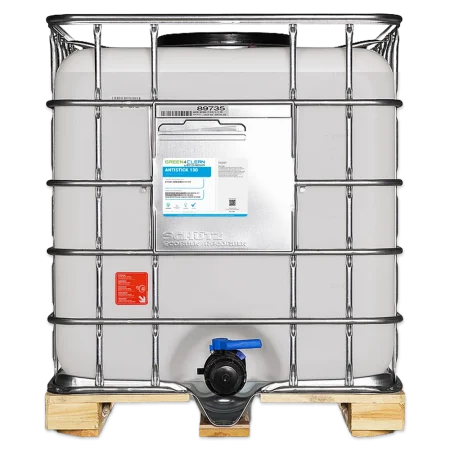
Item number: 0769

Antistick 130

Hydrocarbons C16-C20 (< 2 % aromatics)
Industrial hydrocarbon-based asphalt release agent with improved safety and environmental profile: VOC-free, ADR-free, WGK 1, flash point > 129 °C. For asphalt mixing plants, thermal skips, asphalt pavers and rollers.
Antistick130_IBC_nl

Description of the

Antistick 130 is our modern hydrocarbon-based industrial release agent. It was developed specifically for use in asphalt mixing plants and asphalt transport and combines the proven performance of hydrocarbon-based release agents with a significantly improved safety and environmental profile compared to older formulations.

At its core, Antistick 130 consists of aliphatic hydrocarbons with a chain length of C16-C20 and an aromatic content of less than two per cent. This composition ensures a Long service life on metallic surfaces and a very Low evaporation rate - the release agent adheres reliably and remains effective even at high mix temperatures. At the same time, it has regulatory advantages: With a flash point of over 129 °C, Antistick 130 is classified as non-flammable according to the Industrial Safety Ordinance, the VOC content is 0 %, the product is ADR-free and categorised in water hazard class 1 (slightly hazardous to water).

For users who currently work with classic hydrocarbon-based release agents such as Antistick 140, Antistick 130 is the obvious choice. modern alternative within the same substance class. If you want to go one step further, our rapeseed oil-based Antistick ECO range offers a consistently biobased solution - we will be happy to advise you on which route makes the most sense for your business.

Available in: 20 litre canisters, 200 litre drums, 1,000 litre IBC containers

Advantages

Your advantages at a glance:

  • Prevents the adhesion of bitumen and asphalt of mixing plant and transport components
  • Long service life on the surface - Less re-spraying, lower consumption
  • Low degree of evaporation - Effect is maintained even at high mix temperatures
  • Can also be used with high mix temperatures - Flash point > 129 °C, auto-ignition temperature > 200 °C
  • VOC-free (0 wt-% VOC content) - no volatile organic compounds
  • No dangerous goods according to ADR - Easy transport between building yard and construction site
  • WGK 1 (slightly hazardous to water) - more favourable storage and insurance conditions than products of higher water hazard class
  • Non-flammable in accordance with the Industrial Safety Regulation
  • No SVHC substance (REACH Article 59 / Annex XIV)
  • Can be used pure - No mixing, can be used directly
  • Effective and efficient to use

Application

Antistick 130 is used in the asphalt construction environment in the following areas:

  • Asphalt mixing plants - Interior surfaces of mixing towers, transfer chutes, silo interior walls
  • Thermo trays and thermo containers - Internal surfaces before loading with hot mix
  • Asphalt paver - screed, material intake, auger, tamper
  • Transport skips and lorry bodies - before each loading
  • Rollers - Bandages and tyres
  • Hand tools in asphalt construction

Antistick 130 is used to remove what: Bitumen, asphalt and OPA (porous asphalt).

Technical data

Characteristic value Value
Product basis Hydrocarbons C16-C20 (< 2 % aromatics)
Appearance Colourless liquid
Odour Characteristic
Aggregate state Liquid
Boiling start / boiling range 272-320 °C
Flash point > 129 °C
Auto-ignition temperature > 200 °C
Density (20 °C) approx. 0.9 g/cm³
Water solubility Not miscible
Viscosity (20 °C) < 4 mPa-s
Vapour pressure (20 °C) < 10 hPa
VOC content 0 Weight-%
CLP classification Asp. Tox. 1; H304 (EUH066)
Hazard pictogram GHS08 (health hazard)
ADR / Dangerous goods No dangerous goods
Water hazard class (WGK) 1 (slightly hazardous to water, self-classification)
Industrial Safety Ordinance No flammable liquid according to BetrSichV
Biodegradability Moderately / partially biodegradable
PBT/vPvB (REACH Annex XIII) Not fulfilled
Endocrine disrupting properties None in concentration ≥ 0.1 %

Binding characteristic values: see current safety data sheet (version 3.0.0, as of 15.03.2024) and technical data sheet (version 1, as of 21.02.2024).

Processing instructions

Order type: Spraying (manual or automatic). Recommended is a fine spray mist on the cleaned, preferably clean surface - A complete but thin layer provides the most effective protection. Avoid overdosing, as excess product brings no additional benefit and causes unnecessary consumption.

Mixing ratio: Use pure - no mixing, no dilution required.

Preparation of the surface: Thoroughly clean the surface to be protected before treatment. We recommend pre-cleaning with our water-based cleaning agent Bituclean Extra for heavily humidified surfaces.

Recommended application temperature: 5-30 °C ambient temperature.

Miscibility: Do not mix with bio-based Antistick ECO products. When changing from or to another release agent, rinse the spraying system thoroughly to avoid mixing fractions that can contaminate filters and nozzles.

Repetition: Due to the long service life, re-spraying between loads is not necessary in many applications - the product remains effective on the surface.

SAFETY & SECURITY

Storage location: Dry, cool, well ventilated, protected from direct sunlight and heat. Keep container tightly closed.
Storage temperature: 5-30 °C recommended. Protect from heat.
Original packaging: Only store the product in its original container.
Incompatible with: Strong oxidising agents.

Personal protective equipment:

  • Eye/face protection: Safety goggles in accordance with EN 166 (protection against liquid splashes)
  • Hand protection: Liquid-tight protective gloves. For short-term contact, disposable gloves are sufficient; for frequent contact, gloves tested in accordance with EN 374 (PVC, chloroprene, nitrile or butyl rubber, breakthrough time > 480 min, material thickness > 0.5 mm).
  • Body protection: Suitable work clothing
  • Respiratory protection: Normally not required; provide for aerosol formation in closed rooms.

Safety-relevant information:

  • H304 - Aspiration hazard: If swallowed, do not induce vomiting, seek medical advice immediately. This is the only CLP-relevant classification of the product.
  • EUH066: Repeated skin contact can lead to chapped or cracked skin - use skin protection consistently.
  • Avoid contact with skin, eyes and clothing.

In case of accidental release:

  • Put on personal protective equipment, use respiratory protection for vapours or aerosols
  • Do not allow product to enter drains or bodies of water (WGK 1, mobile in soil)
  • Absorb with liquid-binding material (sand, diatomaceous earth, universal binder)
  • Dispose of collected material in accordance with local regulations
  • Clean remaining surfaces with soap and water

Complete information in the current safety data sheet (Version 3.0.0, as of 15/03/2024) - available on request.

Frequently asked questions FAQ

What is the difference between Antistick 130 and Antistick 140?
Both products are hydrocarbon-based asphalt release agents and cover comparable applications. Antistick 130 is the more modern formulation with an improved safety and environmental profile: VOC content 0 %, flash point above 129 °C, ADR-free, WGK 1 (slightly hazardous to water) and non-flammable according to the Industrial Safety Regulation. If you are currently working with Antistick 140 and would like to stay with the hydrocarbon release agent, switching to Antistick 130 is usually the obvious step. We will be happy to advise you on the specific changeover.
Antistick 130 is the right choice if a hydrocarbon-based release agent is required for process-related or contractual reasons - for example, because specifications or supplier standards stipulate a corresponding formulation. If you are flexible and are looking for a release agent with maximum relief in terms of substance legislation and occupational safety logistics, the bio-based Antistick ECO range is the better choice: no hazardous substance labelling, biodegradable, more skin-friendly and based on rapeseed oil instead of mineral oil.
Antistick 130 is applied pure as a fine spray mist to the cleaned surface - do not overdose, a thin layer without gaps is most effective. Due to the long service life and low evaporation rate, consumption is economical and re-spraying between loads is often not necessary. The exact spray quantity depends on the system, nozzle equipment and mix temperature. Available in 10, 20, 60, 200 and 1,000 litres - so you can procure to suit your business.

Test modern KW release agent

Are you currently using Antistick 140 or a comparable hydrocarbon-based release agent? We will be happy to send you a test sample of Antistick 130 and support you with the changeover - including updated MSDS documentation for your risk assessment.

Company information

Address
Your industry

Contact person

Name

Your enquiry

Product
For which product do you need a quote?
Which cleaner do you currently use?

Contact us now record

Get in touch now. We will usually get back to you within a few hours during business hours.

Name
Address
Your industry
Your request